Losing a tooth can affect more than just your smile. A missing tooth may make chewing uncomfortable and can also change the way your remaining teeth function.
Two commonly considered options for replacing a single missing tooth are a dental implant and a dental bridge.
But which option is better?
The answer depends on factors such as your oral health, jawbone condition, neighbouring teeth, treatment preferences, budget and long-term goals.
Let’s compare single tooth implants vs dental bridges to help you understand the differences.
What Is a Single Tooth Dental Implant?
A dental implant is a tooth-replacement option that uses an implant placed into the jawbone to support a replacement tooth.
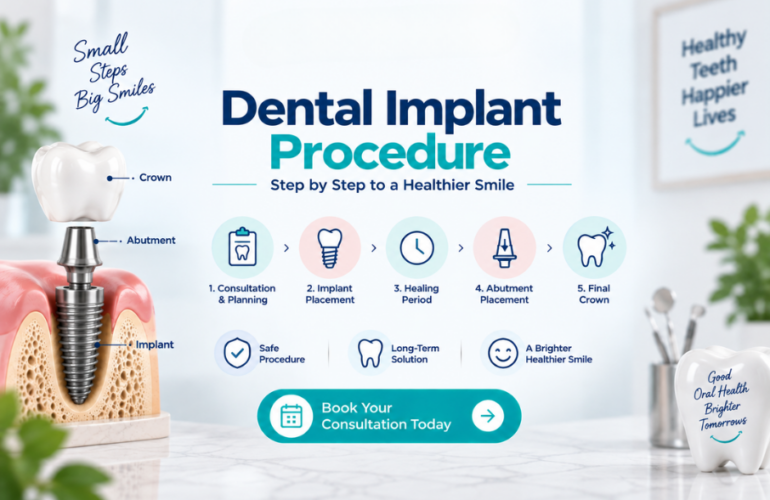
A typical implant restoration involves:
- Dental implant
- Abutment
- Dental crown
The implant acts as the foundation, while the crown replaces the visible portion of the missing tooth.
Because implant treatment involves placement into the jawbone and subsequent healing, it generally requires multiple stages.
What Is a Dental Bridge?
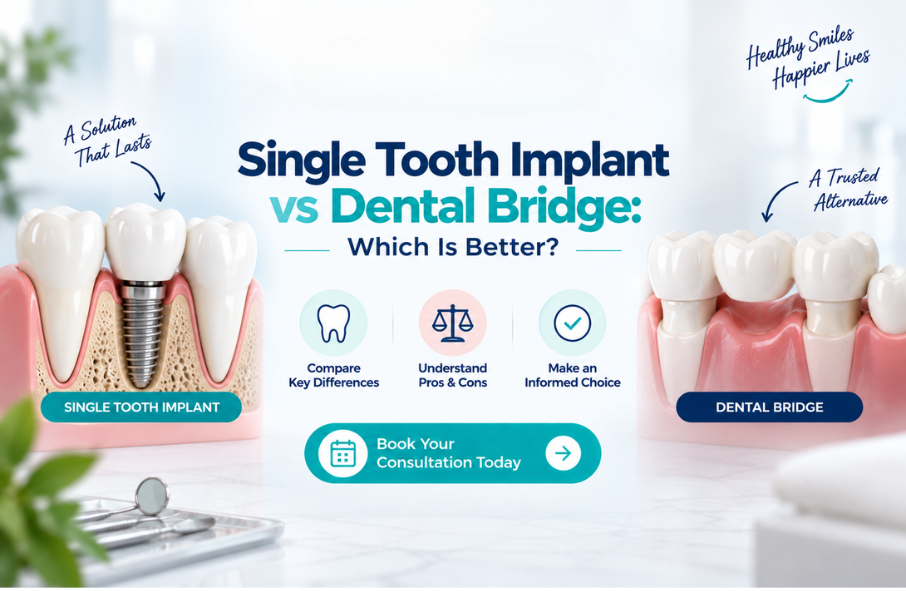
A dental bridge replaces a missing tooth by using the neighbouring teeth or other suitable supporting structures.
In a traditional bridge, the artificial tooth is connected to crowns that fit over the supporting teeth.
Unlike an implant, a conventional dental bridge does not require placing an implant into the jawbone.
The suitability of a bridge depends on the condition and position of the teeth that will support it.
Dental Implant vs Bridge: Key Differences
| Factor | Single Tooth Implant | Dental Bridge |
|---|---|---|
| Main support | Dental implant | Supporting teeth |
| Surgery | Implant placement involves a surgical procedure | Conventional bridge generally does not require implant surgery |
| Treatment stages | Usually multiple stages | Often fewer stages |
| Effect on neighbouring teeth | Does not require them to support the replacement tooth | Supporting teeth are involved |
| Jawbone | Implant is placed in the jawbone | Does not replace the tooth root |
| Treatment timeline | Can involve a healing period | Often completed more quickly |
| Maintenance | Requires normal oral hygiene and professional care | Requires careful cleaning around and under the bridge |
| Suitability | Depends on bone, gums and overall health | Depends partly on supporting teeth |
Which Looks More Natural: Implant or Bridge?
Both dental implants and bridges can be designed to provide a natural-looking result.
The appearance depends on factors such as:
- Position of the missing tooth
- Shape and shade of the restoration
- Gum condition
- Restoration material
- Dental laboratory work
- Dentist’s treatment planning
A properly planned restoration can be designed to blend with the surrounding teeth.
Which Option Is Better for Your Neighbouring Teeth?
This is an important difference between the two treatments.
A conventional dental bridge relies on neighbouring teeth for support.
A single dental implant is designed to support the replacement tooth independently rather than using adjacent natural teeth as bridge supports.
However, this does not automatically mean an implant is suitable for every patient.
Your dentist needs to evaluate the condition of your gums, jawbone and surrounding teeth before recommending an option.
Dental Implant vs Bridge: Which Lasts Longer?
The longevity of either restoration depends on several factors.
These include:
- Oral hygiene
- Gum health
- Bite forces
- Smoking or tobacco use
- Quality of the restoration
- Regular dental check-ups
- How well the restoration is maintained
Dental implants can provide a long-term tooth-replacement solution when properly planned and maintained.
Dental bridges can also provide effective tooth replacement, but they require appropriate care and monitoring.
Rather than focusing only on a specific number of years, discuss the expected lifespan of your particular restoration with your dentist.
Which Is Faster: Implant or Bridge?
A dental bridge may generally be completed in fewer treatment stages than an implant.
Dental implant treatment can involve:
- Consultation and assessment
- Implant placement
- Healing period
- Abutment/restoration stage
- Placement of the final crown
The exact timeline varies depending on the patient’s dental condition and whether additional treatment is required.
If you are looking for a faster tooth-replacement option, ask your dentist whether a bridge is appropriate for your situation.
Which Is More Expensive: Implant or Bridge?
The total cost depends on the treatment plan.
An implant may have a higher initial treatment cost because the process can involve implant placement, healing, an abutment and a final crown.
A bridge may have a different overall cost depending on the number of teeth involved, materials used and complexity of treatment.
When comparing prices, ask your dentist for the complete treatment cost, rather than comparing only the price of an implant or crown.
What About Bone Loss After Losing a Tooth?
A natural tooth has a root within the jawbone.
When a tooth is lost, the surrounding bone can change over time.
A dental implant is placed into the jawbone and can provide a root-like foundation for the replacement tooth.
A conventional bridge replaces the visible tooth but does not replace the natural tooth root.
This is one of the important differences to discuss with your dentist when choosing between the two options.
When Might a Dental Implant Be Considered?
A dental implant may be considered when:
- One tooth is missing
- The surrounding oral tissues are suitable
- There is adequate bone or a suitable plan to address bone deficiency
- Gum health is appropriately managed
- The patient is suitable for implant treatment
- A fixed tooth-replacement option is desired
An examination is necessary to determine whether implant treatment is appropriate.
When Might a Dental Bridge Be Considered?
A bridge may be considered when:
- There is a single missing tooth
- Suitable supporting teeth are available
- The patient wants a fixed replacement
- Implant treatment is not preferred or is not suitable
- The dentist determines that a bridge is appropriate
The condition of the neighbouring teeth is particularly important when planning a conventional bridge.
Dental Implant or Bridge: Which Should You Choose?
There is no universal answer.
A dental implant may be attractive if preserving the independence of neighbouring teeth and replacing the missing tooth with an implant-supported restoration are important considerations.
A bridge may be appropriate when suitable supporting teeth are available and a non-implant fixed replacement is preferred.
Your dentist should assess:
- Missing tooth location
- Gum health
- Jawbone condition
- Neighbouring teeth
- Bite
- Overall oral health
- Treatment expectations
- Budget and timeline
The best option is the one that fits your individual dental needs.
Can You Replace a Missing Tooth Without an Implant?
Yes. Dental bridges are one alternative to implant treatment.
Depending on your situation, your dentist may also discuss other tooth-replacement options.
Each option has different advantages, limitations, costs and maintenance requirements.
A professional evaluation can help you compare them rather than choosing based only on online information.
Dental Implants and Bridges in Pune
If you are considering a dental implant or bridge in Pune, start with a comprehensive dental examination.
At Dental Galaxy, patients can consult professional dental doctors to discuss missing teeth and possible tooth-replacement options.
The appropriate treatment depends on the condition of the missing-tooth area, neighbouring teeth, gums and supporting bone.
A personalised treatment plan can help you understand the recommended procedure, expected timeline and associated costs.
Final Thoughts
When comparing a single tooth implant vs dental bridge, neither option is automatically better for everyone.
An implant can provide an independent foundation for a replacement tooth, while a conventional bridge uses supporting teeth to replace the missing tooth.
Your oral health, jawbone, neighbouring teeth, treatment preferences, timeline and budget all matter when making the decision.
If you have a missing tooth, consult a qualified dental professional before choosing a treatment. A detailed examination can help determine whether a dental implant, bridge or another replacement option is most appropriate for you.