Wisdom Teeth Removal: 7 Signs You Shouldn’t Ignore
Have you ever experienced sudden pain at the back of your mouth, swollen gums or difficulty chewing? Your wisdom teeth could be responsible.
Wisdom teeth are the last set of molars to develop, usually appearing during the late teenage years or early adulthood. While some people experience no problems, others may develop pain, infection, overcrowding or impacted wisdom teeth.
Ignoring these symptoms can lead to more complicated dental problems. Understanding the warning signs can help you seek timely treatment.
At Dental Galaxy, we believe that early diagnosis and appropriate dental care are essential for maintaining healthy teeth and gums.
What Are Wisdom Teeth?
Wisdom teeth are the third molars located at the back of your upper and lower jaws. Most people develop up to four wisdom teeth, although some may develop fewer or none.
These teeth generally emerge between the ages of 17 and 25. However, they may not always have enough space to grow properly.
When a wisdom tooth cannot fully emerge through the gums, it is known as an impacted wisdom tooth.
Common types of impacted wisdom teeth include:
- Mesial impaction: The tooth is angled towards the neighbouring tooth.
- Distal impaction: The tooth is angled towards the back of the mouth.
- Vertical impaction: The tooth is positioned upright but may not fully emerge.
- Horizontal impaction: The tooth grows sideways beneath the gums.
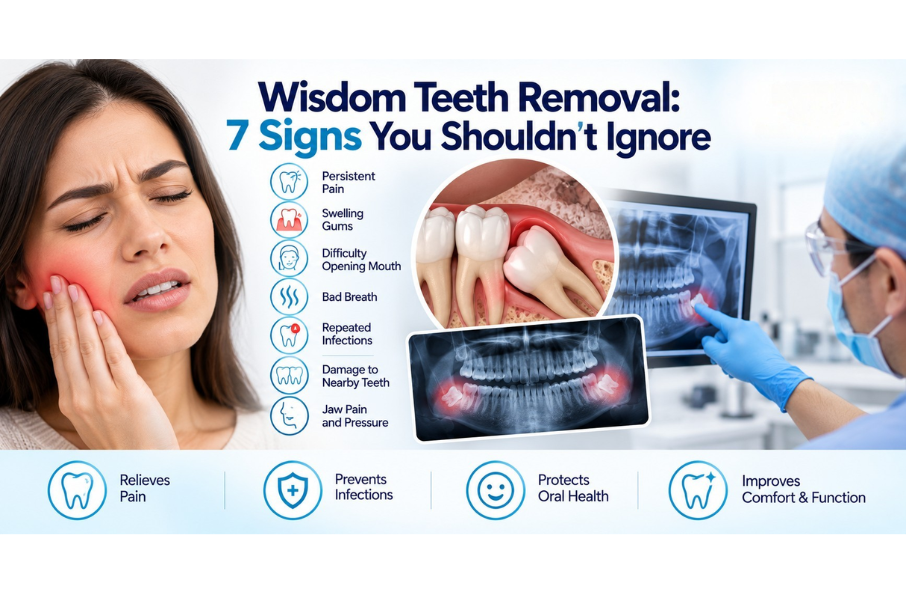
7 Signs You May Need Wisdom Teeth Removal
1. Persistent Pain at the Back of Your Mouth
Pain near the back of your jaw is one of the common warning signs of wisdom tooth problems.
You may experience:
- Continuous discomfort near the last molars.
- Pain while chewing food.
- Pressure around the jaw.
- Pain that spreads towards the ear.
Persistent or recurring pain should be evaluated by a dentist to identify the underlying cause.
2. Swollen or Bleeding Gums
When wisdom teeth partially emerge, bacteria and food particles can become trapped around the gum tissue.
This may cause a condition called pericoronitis, which is inflammation or infection of the tissue surrounding a partially erupted tooth.
Symptoms may include:
- Red and swollen gums.
- Bleeding around the wisdom tooth.
- Tenderness while brushing.
- Unpleasant taste in the mouth.
3. Difficulty Opening Your Mouth
Inflammation around an infected wisdom tooth can sometimes make it difficult to open your mouth comfortably.
You may notice discomfort while speaking, yawning or eating.
If you experience significant difficulty opening your mouth, seek prompt dental evaluation.
4. Persistent Bad Breath
Partially erupted wisdom teeth can create small spaces where food particles and bacteria accumulate.
This may result in:
- Persistent bad breath.
- Unpleasant taste.
- Gum inflammation.
- Difficulty cleaning the affected area.
Professional dental examination can help identify whether the wisdom tooth is contributing to the problem.
5. Repeated Gum Infections
When a wisdom tooth is partially covered by gum tissue, bacteria can accumulate beneath the gum flap and cause repeated infections.
Recurring infections may lead to pain, swelling, pus formation and discomfort while chewing.
Repeated episodes should not be ignored. Your dentist can assess whether extraction or another treatment is necessary.
6. Damage or Decay in Nearby Teeth
An incorrectly positioned wisdom tooth may make the neighbouring second molar difficult to clean.
This can increase the risk of:
- Tooth decay.
- Gum disease.
- Food accumulation.
- Damage to the neighbouring tooth.
Early dental examination can help identify these problems before they become more serious.
7. Jaw Pain and Pressure
Some people experience discomfort or pressure around the back of their jaw when wisdom teeth are developing or becoming impacted.
However, jaw pain can also have other causes, including dental infections and temporomandibular joint disorders.
A proper dental examination is important to determine the actual reason.
Does Every Wisdom Tooth Need to Be Removed?
No. Not every wisdom tooth requires extraction.
If your wisdom teeth are healthy, properly positioned, functional and easy to clean, your dentist may recommend monitoring them instead of removing them.
Extraction may be recommended when a wisdom tooth causes:
- Repeated infections.
- Persistent pain.
- Untreatable tooth decay.
- Damage to neighbouring teeth.
- Gum disease around the tooth.
- Certain cysts or other dental complications.
The decision should always be based on clinical examination and appropriate dental imaging.
What Happens During Wisdom Tooth Removal?
Wisdom tooth extraction is a dental procedure performed to remove a problematic or impacted wisdom tooth.
The procedure generally involves the following steps:
Step 1: Dental Examination
Your dentist examines your mouth and evaluates the position of the wisdom tooth. Dental X-rays may be recommended to understand its position and relationship with nearby structures.
Step 2: Local Anaesthesia
Local anaesthesia is generally administered to numb the affected area and improve comfort during the procedure.
Step 3: Tooth Removal
Depending on the tooth position, the dentist may remove the tooth directly or perform a surgical extraction.
In some cases, a small incision in the gum or removal of a limited amount of surrounding bone may be required.
Step 4: Cleaning and Stitches
After removal, the area is cleaned. Stitches may be placed when necessary.
Step 5: Recovery Instructions
Your dentist provides instructions regarding medication, food, oral hygiene and follow-up appointments.
Is Wisdom Tooth Removal Painful?
Wisdom tooth removal is generally performed under local anaesthesia, which numbs the area during the procedure.
You may feel pressure or movement, but you should not experience sharp pain during a properly anaesthetised procedure.
Some discomfort, swelling and soreness are common after extraction. Your dentist can recommend appropriate pain management and aftercare.
How Long Does It Take to Recover After Wisdom Tooth Removal?
Recovery depends on the position of the tooth, the complexity of extraction and your overall health.
Many patients experience the most noticeable swelling and discomfort during the first few days. Initial recovery often takes several days, while complete healing may take several weeks.
To support recovery:
- Rest after the procedure.
- Follow your dentist’s medication instructions.
- Eat soft foods initially.
- Keep yourself hydrated.
- Avoid smoking and tobacco.
- Avoid vigorous rinsing during the initial recovery period.
- Maintain oral hygiene according to your dentist’s instructions.
Foods to Eat After Wisdom Tooth Extraction
Choosing appropriate foods can help make the recovery period more comfortable.
Recommended Foods
- Curd and yoghurt.
- Mashed potatoes.
- Soft khichdi.
- Bananas.
- Soft scrambled eggs.
- Blended soups that are not hot.
- Soft cooked vegetables.
Foods and Habits to Avoid Initially
- Hard and crunchy foods.
- Very hot foods and beverages.
- Spicy foods that irritate the extraction site.
- Small seeds that may become trapped in the wound.
- Smoking and tobacco products.
- Drinking through a straw.
Follow your dentist’s individual dietary instructions as healing progresses.
When Should You Visit a Dentist Immediately?
Some symptoms require urgent dental attention.
- Severe or increasing facial swelling.
- Fever accompanied by dental pain.
- Difficulty swallowing or breathing.
- Persistent bleeding after extraction.
- Increasing pain or swelling after initial improvement.
- Pus or signs of spreading infection.
Difficulty breathing or swallowing requires immediate emergency medical attention.
Why Choose Dental Galaxy for Wisdom Tooth Consultation?
Wisdom tooth problems can affect your daily routine, eating habits and overall oral health.
At Dental Galaxy, we believe that every patient deserves a proper dental evaluation and an individualised treatment approach.
Our dental care approach focuses on:
- Comprehensive dental examination.
- Assessment of impacted wisdom teeth.
- Appropriate dental imaging when required.
- Personalised treatment recommendations.
- Patient comfort and post-treatment guidance.
- Preventive oral healthcare.
Frequently Asked Questions (FAQs)
1. At what age do wisdom teeth appear?
Wisdom teeth commonly emerge between the ages of 17 and 25, although the timing varies from person to person.
2. Does every wisdom tooth need to be removed?
No. Healthy wisdom teeth that are properly positioned, functional and easy to clean may not require removal.
3. Is wisdom tooth extraction painful?
Local anaesthesia is used to numb the area during extraction. Some discomfort and swelling may occur afterwards.
4. How long does wisdom tooth removal take?
The procedure duration depends on the tooth position and complexity of extraction.
5. How many days does wisdom tooth recovery take?
Initial recovery generally takes a few days, while complete healing may take several weeks depending on the complexity of extraction.
6. Can I eat normally after wisdom tooth removal?
Soft foods are generally recommended initially. Gradually return to your regular diet as healing progresses and your dentist advises.
7. What happens if I ignore an impacted wisdom tooth?
An impacted wisdom tooth may contribute to pain, infection, gum inflammation, decay or damage to neighbouring teeth.
Experiencing Wisdom Tooth Pain?
Don’t ignore recurring pain, swelling or discomfort around your wisdom teeth. Early dental evaluation can help identify potential problems and determine whether treatment is necessary.
Book a dental consultation at Dental Galaxy to understand your wisdom tooth condition and explore suitable treatment options.
Dental Galaxy – Your Smile, Our Priority!