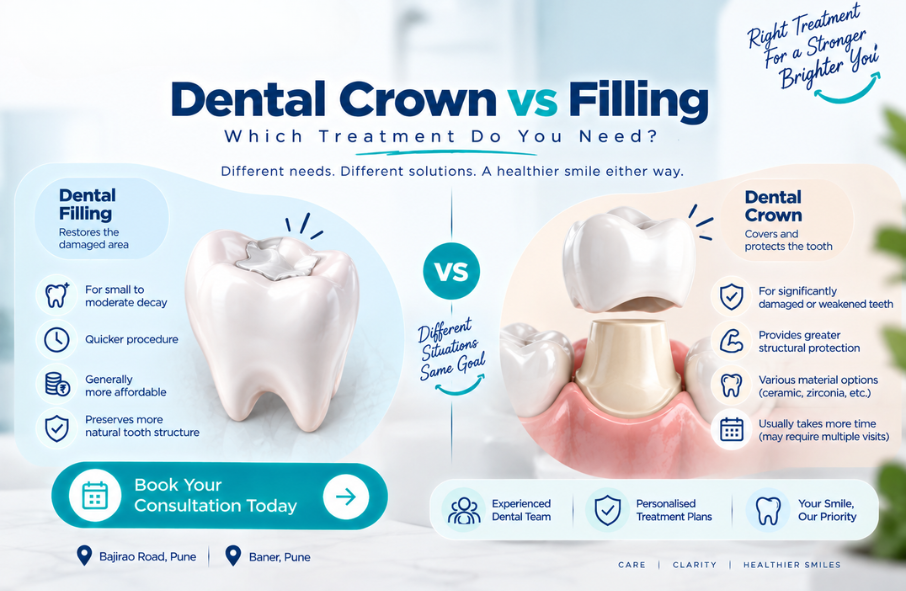
When a tooth has decay, damage or a large restoration, your dentist may recommend either a dental filling or a dental crown.
But how do you know which treatment is appropriate?
The answer depends mainly on the amount of healthy tooth structure remaining, the extent of damage, the location of the tooth and its functional requirements.
Understanding the difference between a dental crown vs filling can help you have a more informed conversation with your dentist.
What Is a Dental Filling?
A dental filling is used to restore a tooth after decay or relatively limited damage has been removed.
The dentist removes the affected tooth structure and fills the resulting area with an appropriate restorative material.
A filling may be considered when enough healthy tooth structure remains to support the restoration.
Common reasons for a filling include:
- Dental cavities
- Small to moderate areas of decay
- Minor tooth damage
- Replacement of an older filling
The appropriate filling material depends on the tooth and clinical situation.
What Is a Dental Crown?
A dental crown is a restoration designed to cover a tooth more extensively.
It may be recommended when a tooth has been significantly weakened, damaged or restored and requires additional protection.
Crowns can be made from different materials, including certain ceramic and zirconia-based options.
A crown may be considered for:
- Significantly damaged teeth
- Weakened teeth
- Certain root canal-treated teeth
- Teeth with extensive restorations
- Selected cosmetic or restorative situations
Dental Crown vs Filling: Key Differences
| Factor | Dental Filling | Dental Crown |
|---|---|---|
| Coverage | Restores a specific damaged area | Covers the tooth more extensively |
| Typical use | Smaller or moderate areas of decay/damage | More significantly weakened or damaged teeth |
| Tooth preparation | Generally more limited | More extensive preparation may be required |
| Treatment | Often completed in a simpler restoration procedure | Usually involves crown preparation and fabrication |
| Material options | Various filling materials | Ceramic, zirconia, metal-based and other crown materials |
| Protection | Restores the affected area | Can provide broader structural coverage |
| Suitability | Depends on remaining healthy tooth structure | Depends on tooth condition and restorative requirements |
When Is a Filling Usually Recommended?
A filling may be appropriate when the damage is relatively limited and enough healthy tooth structure remains.
For example, your dentist may consider a filling for a tooth with a cavity that can be restored without requiring extensive coverage.
The decision depends on:
- Size of the cavity
- Location of decay
- Remaining tooth structure
- Bite forces
- Overall tooth condition
Your dentist will assess the tooth before deciding whether a filling is sufficient.
When Is a Dental Crown Usually Recommended?
A crown may be considered when a tooth has lost a significant amount of structure or needs greater protection.
Possible situations include:
Extensive Tooth Damage
A tooth with substantial damage may not have enough healthy structure to support a conventional filling effectively.
Large Existing Filling
A tooth with a large old filling and limited remaining tooth structure may require a crown depending on its condition.
After Root Canal Treatment
Some root canal-treated teeth may require a crown or another protective restoration depending on the tooth’s location and remaining structure.
Cracked or Weakened Tooth
A crown may be considered for certain structurally compromised teeth.
The treatment decision depends on the extent and location of the damage.
Is a Crown Stronger Than a Filling?
Crowns and fillings are designed for different purposes, so comparing them simply in terms of “strength” can be misleading.
A filling restores a specific area of a tooth.
A crown provides more extensive coverage and may be recommended when a tooth requires additional structural protection.
The appropriate restoration depends on the condition of the tooth rather than simply choosing the stronger material.
Crown or Filling After Root Canal?
This is a common question.
Root canal treatment addresses infection or damage involving the inside of the tooth.
After RCT, the tooth may require an appropriate restoration.
For some teeth, particularly those with significant loss of tooth structure, a crown may be recommended.
However, not every root canal-treated tooth automatically requires the same restoration.
Your dentist can evaluate the remaining tooth structure and determine the appropriate option.
Is a Dental Crown More Expensive Than a Filling?
The cost of a dental crown and filling can differ because they are different treatments.
A crown generally involves:
- Tooth preparation
- Impression or digital scan
- Laboratory fabrication
- Temporary restoration in some cases
- Final crown placement
A filling can often be completed with a direct restoration.
The actual cost depends on:
- Tooth condition
- Restoration material
- Tooth location
- Complexity
- Diagnostic requirements
- Additional treatment
Rather than choosing based on price alone, discuss the most appropriate treatment for your tooth with your dentist.
Dental Crown vs Filling: Which Takes Longer?
A filling can often be completed during a simpler treatment appointment.
A crown generally involves additional steps because the tooth must be prepared and the custom restoration fabricated.
A typical crown process may include:
Examination → Preparation → Digital Scan/Impression → Crown Fabrication → Final Placement
The exact number of appointments varies.
If the tooth requires root canal treatment or other procedures, the overall treatment timeline may be longer.
Which Treatment Looks More Natural?
Both fillings and crowns can be designed to blend with your natural teeth.
The appearance depends on:
- Material
- Shade
- Tooth location
- Restoration design
- Dentist’s technique
- Laboratory work
Tooth-coloured fillings may be suitable for certain visible restorations, while ceramic or zirconia crowns can provide tooth-coloured full-coverage restorations in appropriate cases.
Your dentist can discuss the aesthetic options available for your tooth.
Can a Filling Replace a Crown?
Not always.
If a tooth has lost too much structure, a filling may not provide the level of restoration or protection required.
Trying to restore a significantly weakened tooth with a filling when a crown is more appropriate may not provide the intended outcome.
Your dentist will evaluate how much healthy tooth structure remains before recommending the restoration.
Can You Replace a Crown With a Filling?
Generally, a filling and crown are not interchangeable treatments.
If a tooth has been prepared for a crown or requires extensive structural protection, replacing it with a filling may not provide the same type of coverage.
However, treatment decisions are individual.
If your crown is damaged or needs replacement, your dentist should examine both the restoration and the underlying tooth before recommending the next step.
How Does Your Dentist Decide Between a Crown and Filling?
Your dentist may consider several factors.
1. Amount of Tooth Structure Remaining
This is one of the most important considerations.
2. Extent of Decay or Damage
Larger areas of damage may require more extensive restoration.
3. Tooth Location
Front and back teeth have different functional and aesthetic requirements.
4. Bite and Chewing Forces
The amount of force placed on the tooth can influence restoration planning.
5. Previous Dental Treatment
A tooth that has undergone root canal treatment may require a different restoration approach.
6. Overall Oral Health
Gum health and surrounding teeth may also be considered.
What Happens If You Delay Treatment?
If your dentist has identified tooth decay or structural damage, delaying treatment may allow the problem to progress.
A small cavity can potentially become larger, while a weakened tooth may become more difficult to restore if additional damage occurs.
If you have:
- Toothache
- Sensitivity
- A broken tooth
- Pain when chewing
- Visible decay
arrange a dental examination.
Early assessment can help determine the appropriate treatment before the problem becomes more complicated.
Dental Crown vs Filling for a Broken Tooth
A broken tooth needs individual assessment.
A small chip may be treatable with a filling or another conservative restoration.
A tooth with extensive structural damage may require a crown or another treatment.
The location of the fracture and condition of the remaining tooth structure are important factors.
If a tooth has suffered significant trauma, see a dentist promptly.
How Long Do Fillings and Crowns Last?
Neither treatment has one guaranteed lifespan for every patient.
Longevity depends on factors such as:
- Oral hygiene
- Gum health
- Bite
- Teeth grinding
- Material
- Size and location of restoration
- Condition of the supporting tooth
- Regular dental care
Regular dental check-ups allow your dentist to monitor restorations and identify problems early.
How Do You Care for a Filling or Crown?
Whether you have a filling or crown, good oral hygiene remains important.
You should:
- Brush regularly
- Clean between your teeth
- Maintain healthy gums
- Attend regular dental check-ups
- Avoid using your teeth to open packages
- Tell your dentist if you grind or clench
If a restoration becomes loose, cracked or uncomfortable, arrange a dental examination.
Dental Crown vs Filling: Which Is Better?
There is no universally better option.
A filling may be suitable when a tooth has relatively limited damage and sufficient healthy structure remains.
A crown may be appropriate when the tooth is significantly weakened or requires more extensive coverage.
The goal is to choose the least extensive treatment that appropriately restores the tooth, based on your dentist’s clinical assessment.
Dental Crowns and Fillings in Pune
If you are searching for dental crowns or fillings in Pune, a professional examination can help determine which restoration is appropriate.
Dental Galaxy is a multi-speciality dental clinic in Pune with locations listed at Bajirao Road and Baner.
Patients can consult professional dental doctors for damaged, decayed or weakened teeth and discuss restorative treatment options.
Your dentist can explain the recommended restoration, treatment stages and associated costs based on your individual condition.
Final Thoughts
When comparing dental crown vs filling, the key consideration is the condition of the tooth.
A filling can be appropriate for relatively limited decay or damage when sufficient tooth structure remains. A crown may be recommended when a tooth is significantly weakened and requires more extensive coverage.
Choosing between the two should not be based solely on cost or online comparisons.
If you have tooth decay, a cracked tooth, a large filling or a tooth that has undergone root canal treatment, consult a dental professional for an individual assessment.
For patients looking for dental treatment in Pune, Dental Galaxy can help evaluate the tooth and discuss suitable restorative options.